
Hello friends. The following “letter” is a chapter from my book about the Camino de Santiago that did not find a home with a publisher in its current form. I am at peace with that. While I am carrying on with writing a version of this story that feels right, it’s time to release part of this original manuscript to the world anyway.
A little context: These advice chapters lived in between traditional chapters that followed by 500-miles hike across Spain in 2017 as I processed some tricky memories about my childhood.
I will release a new advice chapter each Wednesday starting today, January 8th, 2025, until they’re complete. If you’re new here, be sure to start from this post, number 1:) Thanks for being here.
If you think this letter is for you , it is.
Dear Pilgrim,
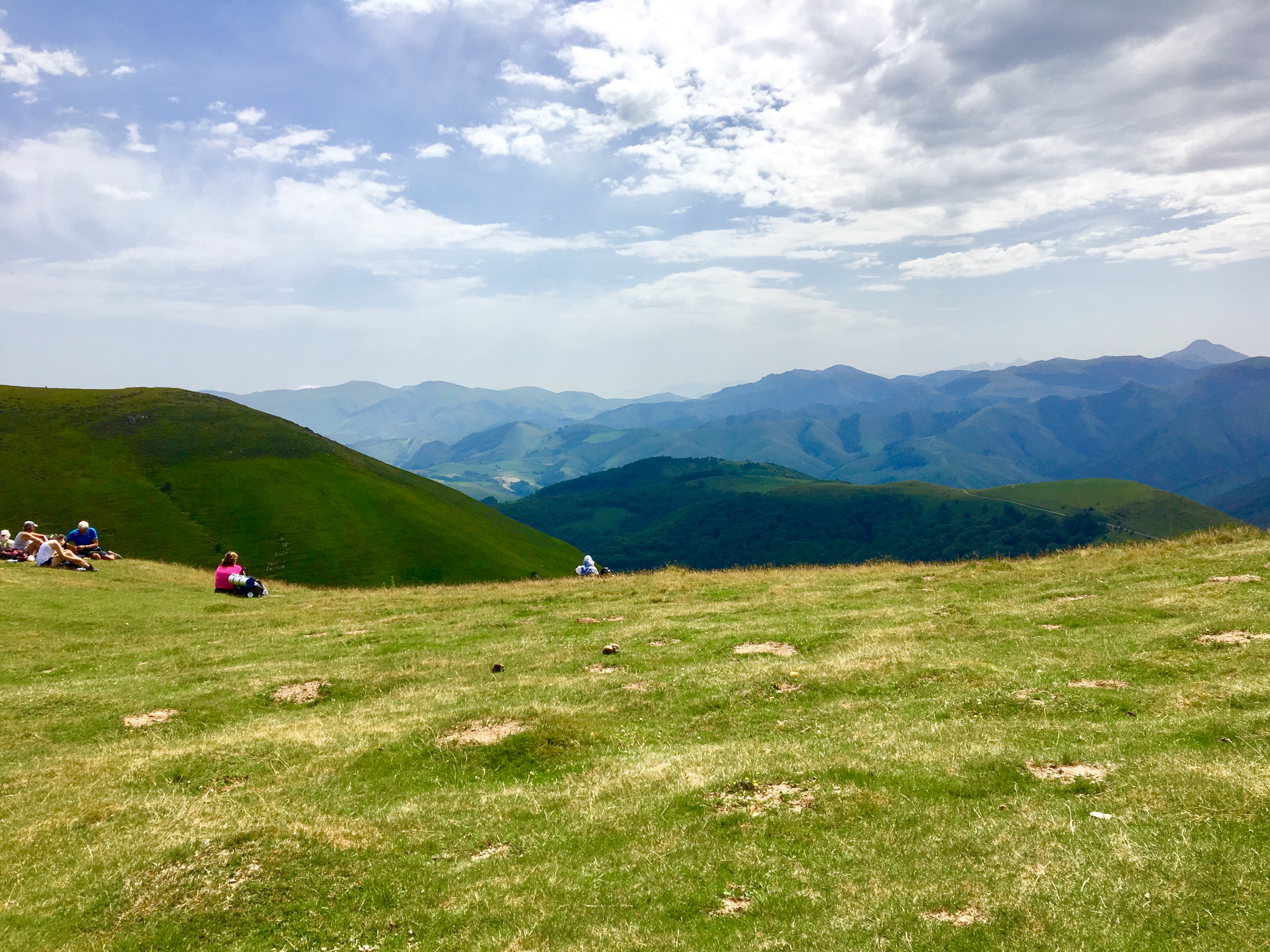
There is a footpath that slips its way through the Pyrenees, tiptoeing over the line where we stop calling it France and start calling it Spain. You’ll find little fanfare at the crossing and no indication of border control, only layer upon layer of tissue paper mountain peaks that fade into the blueness of someone else’s sky.
Over 40 years ago, the Spanish Civil Guard inched a patrol car toward a white van parked on the side of this road. And as the story goes, Don Elías Valiña Sampedro, a diminutive Galician Catholic priest in wire-rimmed glasses, stepped out of the van holding cans of bright yellow paint. When asked what he planned to do with it, Don Elías shouted with joy, “I’m preparing a great invasion…!”
We, it turns out, are the invasion.
The Camino de Santiago is a centuries-old pilgrimage made up of a series of roads that culminate in the city of Santiago de Compostela, or Saint James of the Field of Stars. The Catholics believe that the bones of St. James the Greater (one of the 12 apostles) lie interred beneath the cathedral that towers over the city. While the most popular route commences in a small village in western France some 490-odd miles east of Santiago, there are routes that climb up through Portugal, across central Spain, along the coasts, and everywhere in between. Many pilgrims today walk beyond Santiago to the coastal town of Finisterre—the end of the earth.
Don Elías spent the better part of the 70s and 80s defining the modern-day Camino so that the average seeker could navigate its turns and cross its highways without breaking out a map or knowing how to read the constellations. His painted yellow arrows point the way through the city of Burgos, over the fields of Meseta, up the cliffs to Galicia, and at last, into the Plaza del Obradoiro in Santiago de Compostela.
And he was right about the invasion. Don Elías’s dedication to accessibility caused the pilgrimage to flourish for the first time in decades, reaching levels it hadn’t seen in nearly 1,000 years. The difference this time is that the road’s siren song now calls to far more people than the religiously devout—though they still come as well. His invasion gave a home to the seekers, the confused, the angry, the ambivalent, and everyone who promised their childhood selves that one day they’d get up and go on a real adventure. The word “pilgrim” has finally returned to its home, beyond the Americanized image of early colonizers, and simply back to someone who asks, “Why?”
But did Don Elias imagine us as his invaders? The breaking news-weary, side-hustling, burnout experts that lost their identities somewhere between the last international tragedy and the next layoff? Did he envision the invaders as retired teachers, cast-away artists, tired bartenders, off-beat hedge fund managers, and in-between-jobs-30-somethings seeking more than yet another attempt at stability? Did he know that he was building a bridge to a world previously reserved for muscle-bound hikers, unmoored travelers, and devoted Christians? Did he know when he built it, that we would come?
Pilgrim is an unshakable identity. It cannot be questioned and cannot be taken from you. Not by another “I’m sorry but we’re going another direction,” email. Not by a breakup phone call. Not by divorce papers. Not by pink slips. Not by long calls from the doctor’s office. Not by eviction notices. Not by the passage of time. Not by the unthinkable.
The Camino is not just for the athletic, outdoorsy, or spontaneous. It is also for the Girl Scout dropouts, the D-minus gym students, and those who sat lonely and frustrated in the back of church or the classroom.
Over a millennium of safety nets—including those woven together by Don Elías—allow those without hiking or backpacking experience to start walking with minimal planning if they choose. Hikers on the Camino primarily stay in what’s known as albergues—hostels for pilgrims. Their hosts provide shelter, a shower, a bed, and often a meal. There’s no need to bring a tent, a compass, or climbing gear. All you have to do is look out for the false claims there is a way to “do it correctly.”
Book a bed ahead of time or walk up to the door and ask if there is still room. Walk three miles each day or 30 miles each day. Walk for five days or 50 days. Wake up at 5 a.m. or 10 a.m. Walk alone or together. Leave with a specific question or leave because you can’t remember what the question was.
Set the table each night for 20 people, carrying out pans of paella, bottles of red wine, and pots of homemade pasta. Save a seat for the new friend you met in the last village, for the woman from Poland who hurt her foot, for the nice girls from the States who like to talk a lot. Clink glasses and applaud your host for the offering of food that will fuel you through the mountains the next morning. Go to bed laughing and tired and full.
Wake up each morning and lean down in the darkness to search the floor for your socks and shoes. You laid them out the night before. They’re right where you left them. Slip them over your sore feet, over a bandaged blister, and a swollen toe. Pull your shoes over your heel and tie up the laces. Quietly—careful not to wake your fellow pilgrims—slip out the door and step into the violet morning light with your scant belongings on your back. Be sure to fill up your water in the fountain by the cathedral. Look for a yellow arrow. Go.
 Maybe There Will Be Cupcakes
15 responses to “1. Dear Pilgrim: On Identity”
[…] To read more context for the letter below, check out this post here:) […]
LikeLike
[…] To read more context for the letter below, check out this post here:) […]
LikeLike
[…] To read more context for the letter below, check out this post here:) […]
LikeLike
[…] To read more context for the letter below, check out this post here:) […]
LikeLike
[…] To read more context for the letter below, check out this post here:) […]
LikeLike
[…] To read more context for the letter below, check out this post here:) […]
LikeLike
[…] To read more context for the letter below, check out this post here:) […]
LikeLike
The name of each town makes my heart creak in my chest. 😦
LikeLiked by 1 person
[…] To read more context for the letter below, check out this post here:) […]
LikeLike
[…] To read more context for the letter below, check out this post here:) […]
LikeLike
[…] read more context for the letter below, check out this post here:) An extra note this week. In the context of my book, the term “Richard Peregrino” […]
LikeLike
[…] To read more context for the letter below, check out this post here:) […]
LikeLike
[…] To read more context for the letter below, check out this post here:) […]
LikeLike
[…] To read more context for the letter below, check out this post here:) […]
LikeLike
[…] 1. On Identity […]
LikeLike